Select your language




Bank Vole
Scientific name: Myodes (Clethrionomys) glareolus
Family: Cricetidae
Appearance: The Bank Vole is generally mouse-like in appearance but is stouter with a rounder head and small eyes and ears. Its tail is also much shorter than a mouse being around two thirds the length of its body. Its fur is a warm red-brown colour with greyish underparts.
Size: Head and body 8-12 cm; tail 3.3-4.8 cm
Natural History: The Bank Vole lives in woodland and hedgerows in an underground chamber that is lined with moss and feathers where it will store food for the winter. Its diet consists mainly of buds, seeds, leaves and fruit but will occasionally take small insects. Bank Voles are active at any time of day or night and throughout the year, they are solitary and males and females have their own home ranges. Breeding begins in March and continues through to October - or later in mild winters. Females will mate with the dominant males in the local population and may produce 8 or 9 litters of up to 4 young per year. The pups are born blind and helpless but develop rapidly and are weaned at between 20-25 days. They are sexually mature by the age of 8 weeks. Bank voles are an important dietary item for many species such as stoats, weasels, kestrels and owls.
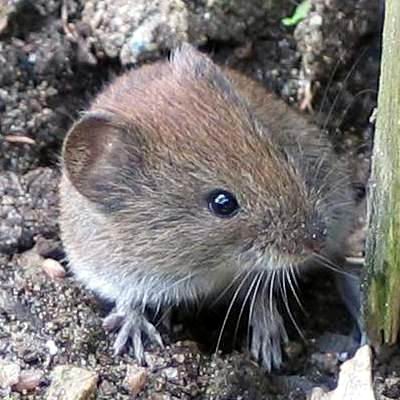
Image: CC BY-SA 3.0