Select your language




Brown Rat
Scientific name: Rattus norvegicus
Family: Muridae
Appearance: The Brown (Common) Rat is much larger than all mice but is of a similar size to the Water Vole. It has greyish-brown fur and, unlike the Water Vole, a very pointed snout and large ears. Its tail is long, broad and scaly, in comparison the Water Vole has a relatively short tail.
Size: Head and body 21-29 cm; tail 17-23 cm
Natural history: The commonly quoted ‘fact’ that you are never more than six feet from a rat is untrue as it is estimated that less than 1% of buildings contain rats. However, they are extremely adaptable omnivores and can survive in environments not suited to other mammals. Their diet is very wide and they can and will eat anything from grain and seeds to fish, molluscs and birds. Brown rats are active throughout the year and are mainly nocturnal but can be seen during the day where food is abundant. They live in loose colonies and dig their own burrows; home ranges vary considerably depending on food availability.
Females are sexually mature from the age of 3-4 months when they will start to breed producing up to six litters a year. Litter size increases with age with older, larger females giving birth to 11 or more young. The offspring are born blind and hairless but mature quickly and are weaned at around 6 weeks. Young rats are an important food source for a range of predators including owls, polecats, stoats and foxes.
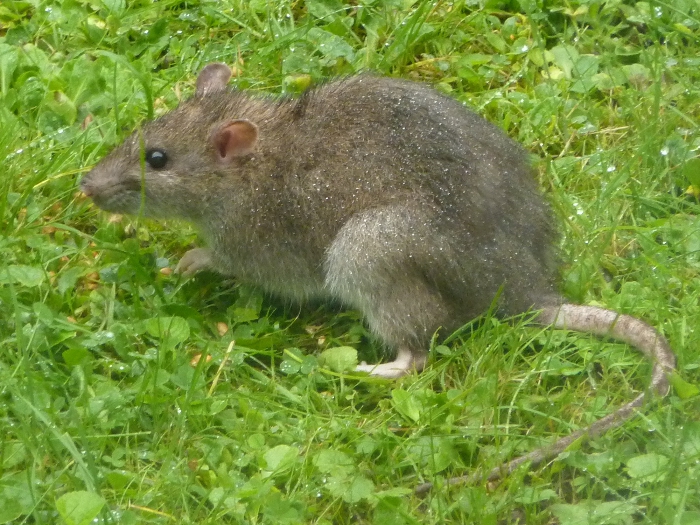
(C) Sarah Gould (shared under a CC BY-SA 2.0 license)